Posted by Jess
7 October 2010

On October 5th, we hit the two month anniversary of our move to Japan.  Since my last few posts have been the thoughts of others, I wanted to post some personal observations about life here in Tokyo as it relates to eating.
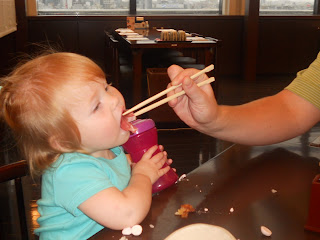
To-Go or Take-Away food is not very common here.  For most restaurants, if they have anything at all that can be taken to-go, it says "take away" on the menu so you know it's ok to ask for it to go.  You do not take leftovers with you home from a restaurant.  Places like Starbucks do take-away and package your drink(s) and food item in a bag for you.  This is because people don't eat or drink in public - like on the train or walking down the street.  So typically for me it would work like this - Starbucks is between my house and the train station.  So I stop in, order my coffee and breakfast as take-away.  It comes in a paper bag with a cup holder inside the bag and a pick to keep the coffee from spilling.  I carry the bag onto the train with me but do not drink or eat on the train.  At first, I felt uncomfortable even having the stuff on the train with me even though I wasn't drinking it.  But recently I've noticed more that people have drinks in their hands or bags with them - but they do not drink or eat it on the train. 

So then I get off the train and walk to work about another fifteen minutes.  And although during this time I feel a bit more comfortable taking out my drink and enjoying it on the walk, I have noticed that people don't generally have beverages in their hand - which is odd to me since there are like 1.6M vending machines in Tokyo (that is not an exageration - they say 1 machine per every 23 people - there are 4 on the floor of my office building alone).  Where are they drinking the things they buy from these machines?

An outcome of this phenomenon of not eating outside is that there are few garbage cans on the street or on the train platforms. But there's no litter either. So I'm not quite sure how that combination works, but it seems to be working for them so I'll go with it. I have to say though that with two little kids, I want more garbage cans. Who wants to carry around a snotty tissue for the rest of the day? Or the wrapper from a snack that a certain 15-month old could not wait for?

As far as lunch time at work, very few people eat at their desks. I think that's part of the fact that people do not bring a lunch from home very much nor do they cook at home very much. We do have a multi-purpose room in it. Take-away sections at the market and convenience stores are crammed with people during the lunch hour and every night from 5pm on. I believe this is mostly due to the fact that kitchens and refrigerators are so small that most people do not cook in their homes. And since most people here do not get married until later in life (at least compared to the US), how often do you really cook for just yourself? And they do not entertain at home either - if you want to meet with friends, you meet at a restaurant or bar, but not generally at your house. The houses just aren't big enough to have people over.

Eating out can be as quick or as formal of an experience as you like. There are ramen shops where you stand at the counter and quickly eat a bowl of noodles, places where you cook your own pancake type meals or the fanciest of the fancy here. But again, no leftovers to take home with you. Portions are small but once you get used to that they are very filling. And a lot of restaurants menus change a little bit based on what they have on hand that day or week. Lunch places sometimes run out of food, dinner places will say "we ran out of that" more than you hear in the states. Less food is kept on hand which means your meal is fresher and tastier. Amen to that.

Before drinking with friends, its customary to toast with "Kanpai!" (Cheers!) and before starting your meal, you say "Ih-ta-da-ki-mas" (I gratefully receive).

Bring on October, post-season baseball, fun with friends both here and in the US, and Kiki-fest 2010. There will be lots to blog about as we enjoy more of what Japan has to offer with my sister. Plus she takes lots more pictures so the blog will get more interesting again.

Kanpai!

Jess

Posted by Jess   

2 October 2010

I saw an article in Tokyo Families magazine last month and thought it was interesting.  It reminded me of how we've always been told the Inuit people have more words for snow than we do in English (which isn't true I guess, but not the point) - just that some thing so simple takes on such a higher amount of significance when it is so critical to survival and culture.  What we just call rice, the Japanese think a lot about.


The article is called "The small yet mighty grain" by Steven Lebovits.  I wanted to post the entire article here, but I worry about copyright issues and I don't want any legal trouble!  So if you are interested in learning more about the history and significance of rice in Japanese culture (in 10 minutes or less!), you can read the article on their website here.

Kanpai!
Jess

p.s. 5 days until my sister's visit!  hooray!
Posted by Jess
26 September 2010

A boring weekend at home here for the Woehrles.  Yesterday we didn't head out much at all, except Jason took Ella on a quick bike ride in the morning and found out it was rainy and windy.  After that, they went to the lounge area of our apartment building to watch Toy Story on the big screen.   And that was about it for Saturday.  Today was church and then a trip to the farmer's market and grocery store and watched a random parade go past our apartment building (but we have no idea what it was for).  Like I said, not a lot of excitement!  But after traveling the past few weeks it was really nice to just hang close to home.  So since nothing new is going on, I thought I would post a little information about Japan.  I found a few good sites with info on them.  First, from facts-about-japan.com


Japan is located in the North Pacific off the coast of Russia and the Korean peninsula. The area of Japan is 377,873km², which makes it slightly smaller in land mass than California. 

Japan is over 70% mountainous terrain with approximately 18% of the land mass suitable for settlement. Japanese cities are typically sprawling and densely populated.
The islands of Japan are located in an area known as The Ring of Fire in the Pacific. This is an area with many earthquakes and volcanic eruptions. Japan is very seismically active with over 1,500 earthquakes per year - Most of which you can't even feel.  I haven't felt one yet, but I do have to keep a hard hat under my desk just in case and we know where to meet Ella and her school class in our designated evacuation zone if there's a big earthquake - but no worries, Mom!

Japanese is the official language of Japan. Many Japanese also have some ability in writing and speaking English as it is a mandatory part of the curriculum in the Japanese educational system. Japanese uses four different writing systems; Kanji (Chinese characters), Hiragana (phonetic alphabet for native words), Katakana (phonetic alphabet for foreign words), and Romaji (western alphabet used to write Japanese).   I want to learn Katakana, as that gets you by in a lot of restaurants and cafes (things like Latte and Pizza are foreign words, so they are written with the katakana alphabet.  Romaji is barely written here, it's just the phonetic spelling for us westerners and the only place its really used is on subway and street signs, which don't get me wrong, is super helpful)

There are over 127,078,679 (July 2009 est.) people living in Japan. For most of Japan's history its borders were closed to foreigners. As a result, Japan's society is very homogeneous, composed of 98.5% ethnic Japanese. The remaining 1.5 percent are mostly Korean, who number around 1 million. There are also considerable numbers of Brazilians, Chinese, and Filipinos residing in Japan. There is also an ethnic minority of indigenous people, called Ainu, who live mostly in northern Hokkaido.

Tokyo, a megalopolis and capital of Japan, is located on Honshu island. Central Tokyo has a population of 12 million people, with the population of the Greater Tokyo Area estimated at over 35 million people.  So even though the country of Japan is the same size as the state of CA, the entire state of CA has a population of about the same as the Greater Tokyo Area. 


In 2009 Tokyo was named the world's most expensive city for expatriate employees, according to the Mercer and Economist Intelligence Unit cost-of-living surveys.  Foreigners are known as gaijin (pronounced guy-gin).   I saw an article that said there are about 320,000 expats in Japan, but I cannot find the article again now to know how old that number was - it said that the American population of that was about 20,000.  We've noticed that there are a lot of Brits and Australians here as well!

Kanpai!
Jess
Posted by Jess
25 September 2010

Tonight - in real time - we give our reactions to two new flavors of ice cream!


#1 - Cookies and Green Tea - could it really taste like seaweed and oreos? At first, Jason says this didn't taste too different, but now that's been able to get a little more cookie in it, he thinks its pretty good.  Since I was not a fan of the plain green tea (but do like oreos!) I decided not to give this one a try tonight.


#2 - English Milk Tea - Took a sniff.  To me, for some reason, it smells like the stuff they use to make a dental impression.  Jason says that's not a good sign, but also doesn't think it smells like that.  Ok, going in for the first taste...and...ok that is nasty.  And the aftertaste just keeps getting worse.  It's really like english tea.  Seriously, couldn't they add the sugar to it?  Jason says "it tastes like tea and milk, which is kinda the point".  He's so practical.  He thinks it tastes ok, but also is a fan of tea, which I really am not.  I think I'm going to grab the plain chocolate ice cream that's hanging out in the freezer and just go for that tonight!

I have also started the countdown to when my sister arrives for a visit - 12 days and counting!  It will also be a busy blog time as we get out and cram in as much Japan as we can in 10 days.  We are so excited!

Kanpai!

Jess
Posted by Jess
23 September 2010

Today was a national holiday in Japan for the Autumnal Equinox.  First day of Fall is considered a holiday.  I'm OK with that!  Ella still had school today so we took the opportunity to visit the Edo-Tokyo Museum.  This museum is about the history of Tokyo from the Edo period of Japan, which is what Tokyo was called until about 1870 or so up to Tokyo during WWII. 

The Edo period was the time of the samurai and the museum talked a lot about what life was like for samurais.  It did not seem so exciting for them, that's for sure!  The museum said that they got paid too little to feed their families and that they didn't have very much to do.  Doesn't sound like a great life to me!  The museum also had exhibits about general life in Edo at the time (1600-1900), like housing, money and culture.  Most displays had Japanese and English markers and we got the audioguides too.  


Jason inside a palanquin, the thing they carried important people in when traveling or in processions.  This one was for "daily" use by a lord and was not as decorative as many of them usually are.  It was roomier than it looked, but probably wouldn't be fun to sit in for a few hours!


One of my favorite pieces of information from the exhibits was that the Edo people thought that earthquakes were caused by a giant subterranean catfish.  Such a better theory than tectonic plates.


A typical Japanese house.  This picture makes it look spacious - it's not!  It was a one room house that was about 10sq meters big (100 sq feet).  This is meant to depict a house just after childbirth - the new baby is being bathed and the mom is sitting in the corner, the mom traditionally sat upright for 7 days and nights after having children.  The houses were all very close together as well, with paper type material for walls and wood posts.  This meant that when fires happened, it spread very quickly.  All wards of Edo had their own fire departments and arsonists were severely punished - burned alive if caught.  It said that Edo had a major fire at least once a year.  


A replica of a famous play done in Kabuki theater.  At first, geishas (or courtesans) were used for the female parts, then that was outlayed and boys were cast for female parts.  Then that was outlawed and young men were cast for the female parts and that was how it pretty much stayed, which is why we think of kabuki as only having men in the cast.  There was also a display showing how the backstage area of kabuki theaters worked.  Kabuki was very big on trickery with the staging to make the appearance of ghosts and mystical creatures. 


Abby got a little antsy so we went up to the 7th floor of the museum for lunch.  This was the view from there.


We both had set meals for lunch - Jason had the Ooedo Lunch Box which had pickles, miso soup, rice, sashimi, and cooked vegetables. 


Abby shared with both of us (I had some deep fried chicken and rice) and liked Jason's sashimi, which was salmon. 


Unfortunately Abby got too bored for us to go down and look more at the Tokyo side of the exhibit - this was the piece all about Tokyo up to and during WWII which would have been very interesting, but I'm sure we'll see more about that part of history in other places too. 

Jason kept Abby occupied on the way back on the train with his iPhone.  She was watching Backyardigans.


The rest of the day has been rainy.  So we picked up Ella from school, let her splash in the puddles on the way home, and are just hanging out at home tonight.  A great holiday!  And even better, back to work tomorrow and its Friday.

Kanpai!
Jess
Posted by Jess
22 September 2010

Tonight's flavor: Cookies and Sesame Cream!

Jason enjoyed this treat tonight while I went for plain vanilla ice cream.  I did try a bite of the new flavor though.  The sesame seed flavor is pretty overpowering at first, but then after a bit you can taste the cookies, which must be of the peanut butter variety.  It's pretty strongly flavored (or at least seemed so after my plain vanilla).  Jason says "it's pretty nutty, I'd get it again".  I think he should start working as a food critic!

Tomorrow is a public holiday for the first day of fall.  Ella does have school so I think Jason, Abby and I are going to head out to a museum if we can.  It's hard to go to those with a four year old!  It's supposed to be a rainy first day of fall too so a museum should be a good choice.

Kanpai!
Jess
Posted by Jess
20 September 2010

Today is a National Holiday in Japan - it is Respect for the Aged Day.  Public Holidays in Japan are called "Red Days" because the date is usually printed in red on local calendars for holidays.  Respect for the Aged Day is just what it says - a much more respectful Grandparents Day, but you don't have to be a grandparent to be respected.  Some places have celebrations that people can go and see, although it sounds like some of them are limited to people who qualify as aged (which seems to be age 60).  I read somewhere that with Japan's aging population the age to be considered an aged person is moving up to 65.  Our apartment staff didn't know of any places where we could see any festivities.  Most of what I've read about observing Respect for the Aged Day is just spending time with elders, bringing them food, taking them to their favorite places and in general just saying "I Love You".  So to all the over 60 people reading this, we love you!  Thanks for all you teach us about life every day.

Since there wasn't much going on in the public holiday department, we headed to a big sports area near here to let the kids play and for me to check it out.  Jason and the girls went there on Saturday too, but I was en route to Japan so I was curious.  The area we were in is called the Meiji Jingu Outer Gardens.  This is an area surrounding the Meiji Shrine and includes a lot of the national sports arenas, baseball fields, small driving range, running paths and in general a lot of nice places to be outdoors.  The weather has cooled down (it was only about 80 today and there was a breeze) so it was a great day for a longer walk and fun on the playground.  This park costs 200 Yen for adults, 50 Yen for youth and free for kids under 2.  Why pay for a playground?  Well hopefully the pictures tell you why.  This place was hopping and it was great!  Big jungle gyms, longest slide I've ever seen, trampoline and zip line.  Yep, zip line.  Here are some pictures and videos of the girls having fun.

Kanpai!
Jess
on our way into the park

The building in the back is the Meiji Emperor Picture Gallery (a cloudy day today!)
Entrance to the Kids Park
The Jungle Gym

 
Ella and Abby on the loooonnnnggg roll-bar slide!

sharing ice cream on the way home